
Vacuum Impregnation System
This system is primarily used for porous materials such as ceramics and sprayed coatings, reinforcing fragile materials and enhancing their structural integrity. For this application, Epoxy resins are utilized due to their low viscosity and low vapor pressure. When mixed with a fluorescent dye, they can be used for pore detection. Vacuum impregnation is performed by placing the mount into a bell jar connected to a vacuum pump via tubing and connectors. The vacuum removes any trapped air from the epoxy encapsulating the sample. The displaced air is then replaced with epoxy, providing complete bonding and support.
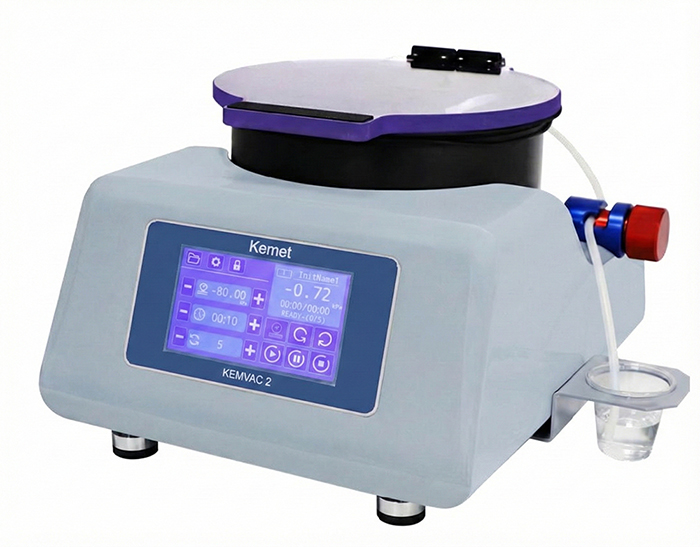
Kemvac 2 - Vacuum Impregnation Unit
The KemVac is engineered for embedding and impregnation of porous materials. It removes trapped air from the mounting material and eliminates gaps between the specimen and the resin.
- Can be used with either a vacuum pump or compressed air supply
- Compact and user-friendly design
- Highly efficient impregnation
- Multi-specimen capability
- Electrical Requirements: 200-240V, 50Hz, 35W (excluding vacuum pump)
- External vacuum pump (optional) 350W
- Vacuum Level: 0 to -80kPa, vacuum pump 0 to -90kPa
- Vacuum chamber size: 252mm diameter
- Product Code: 346172
- Kemvac 2 pump - Product Code: 346181
Advantages of Using Vacuum Impregnation
Encapsulation and/or impregnation of a sample with resin, particularly if it is soft, powdery, cracked, brittle, friable, or broken, is beneficial to: (a) fill voids, pores, and cracks; (b) improve overall integrity and ease of handling; (c) preserve the original microstructure and distribution of components and edges in the sample; (d) keep detached, de-bonded, or fragmented portions adhered to the rest of the sample; and (e) prepare a solid mass from the original fragmented or powdery sample for sectioning, grinding, thin-sectioning, or polishing. Encapsulation refers to immersion of the sample within a resin in a mold to improve the external integrity of brittle, friable materials and facilitate better handling for subsequent sampling steps, whereas impregnation refers to injecting or penetrating liquid resin into a porous sample to improve both its internal and external integrity. Epoxy-based resins are ideal for both encapsulation and impregnation. The lower the viscosity of the epoxy, the greater its depth of penetration into the sample during impregnation, resulting in superior mechanical bonding to the constituents.
